The challenge
Kangra District sits in Seismic Zone IV–V. The 1905 Kangra earthquake (magnitude 7.8) remains one of the deadliest in Indian history. A century later, the building stock that will face the next event is being built, extended and modified daily by masons working without formal earthquake-resistant construction training — and the existing stock has never been systematically surveyed for vulnerability.
HimNIRMANAC addresses both sides of that gap through a single integrated programme: train better, survey continuously, surge in emergencies.
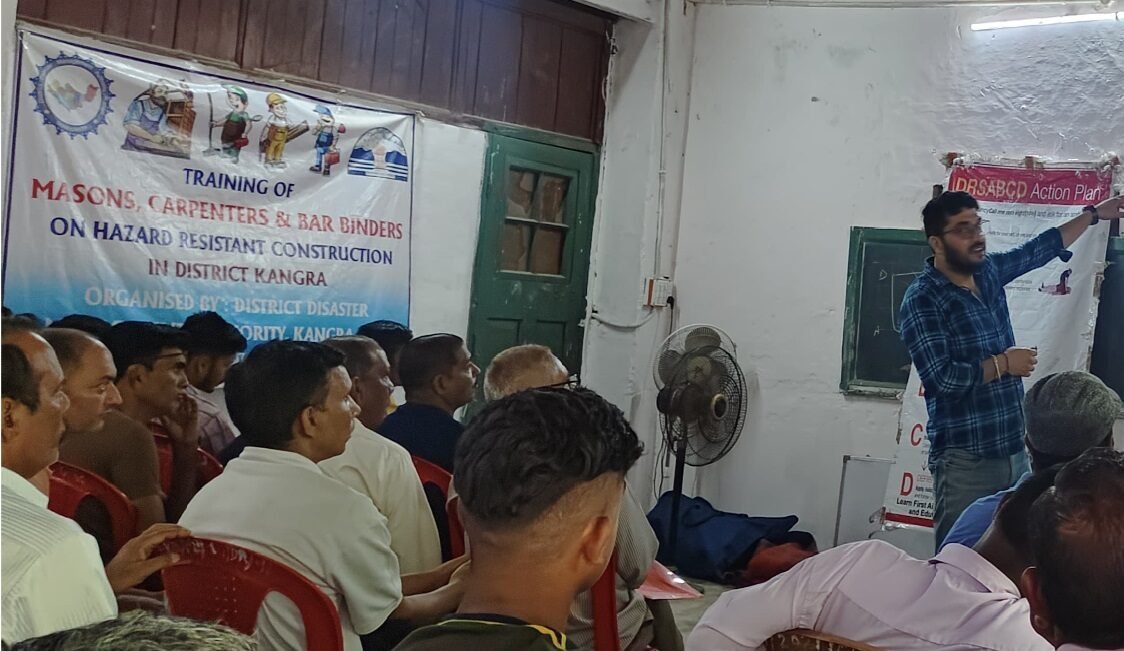
NirmanNAYAK — the trainee workforce
A field cohort recruited from across Kangra's 18 blocks, with minimum 20% women's representation. The curriculum integrates earthquake-resistant construction skills (Construction Skill Development Council of India / CSDCI-aligned) with field-deployable Rapid Visual Screening competencies. Year 1 cohort: 45 trainees in three staggered waves of 15. Year 2 scale: 90 trainees.
Monthly rhythm
The training and deployment cycle runs on a four-week pattern:
- Week 1 — Return. Theory and classroom work at the HimNIRMANAC Kendra or a satellite training site.
- Weeks 2–3 — Field. Active field placement on construction sites, RVS surveys, or supervised retrofit work.
- Week 4 — Free / Consolidation. Personal time and learning consolidation.
Dual capability
This is the architectural insight that makes HimNIRMANAC distinctive: the same workforce that builds safer in routine times becomes the rapid building-damage assessment surge capacity when a trigger event occurs. One investment, two strategic capabilities. The Year-1 cohort RVS capacity of 3,500–6,000 buildings/year across the 18 blocks of Kangra District is a direct outcome of this dual design.
Convergence
HimNIRMANAC operates at the intersection of multiple national frameworks: NDMA / IIT RVS methodology · CSDCI training architecture · DAY-NRLM women's component · Aapda Mitra volunteer linkage · operational interface with DDMA Kangra and HPSDMA.