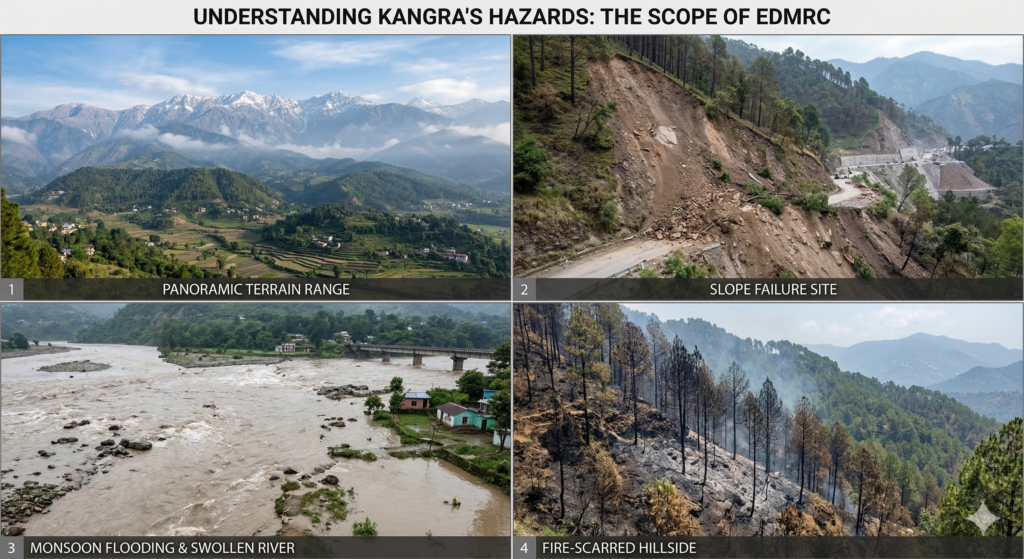
The Emergency and Disaster Management Resource Centre for Safer Lives & Resilient Communities at Kangra (EDMRC Kangra) is an institutional initiative of EduCARE India, a non-governmental organisation established in 1994 and operating primarily in Kangra District, Himachal Pradesh and its surrounding districts.
Over three decades, EduCARE India’s sustained field presence in one of India’s most geologically and climatically complex regions has produced deep operational knowledge of multi-hazard environments. Kangra District’s terrain ranges from approximately 500 to 5,500 metres above sea level, encompassing river valleys, steep slopes, alpine meadows, and dense forest cover. This landscape produces an overlapping hazard profile: seismic risk (Seismic Zone IV–V), monsoon-triggered floods and flash floods, landslides and slope failures, soil subsidence, and seasonal forest fires.
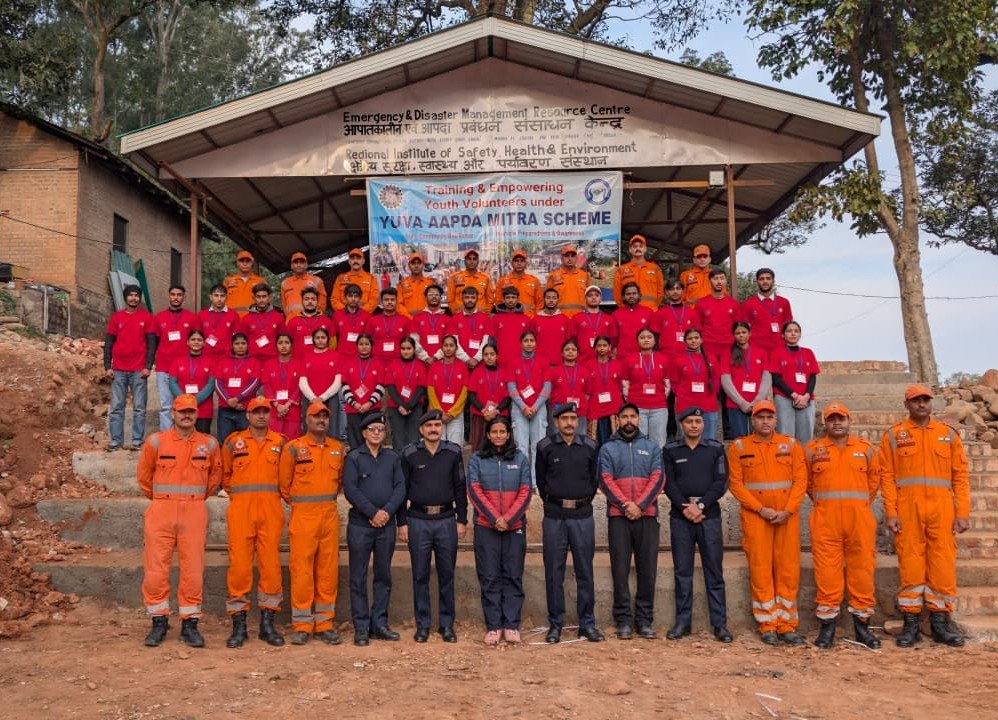
EDMRC was established to institutionalise the disaster management expertise accumulated through decades of community engagement — moving from project-based interventions to a permanent resource centre model that serves as Kangra’s hub for community-based disaster risk reduction (CBDRM), emergency response coordination, volunteer training and deployment, hazard research, and capacity building.
EDMRC operates at the intersection of government disaster management frameworks and grassroots community structures. The centre maintains active working relationships with the District Disaster Management Authority (DDMA) Kangra, the State Disaster Management Authority (SDMA) Himachal Pradesh, the National Disaster Management Authority (NDMA), the National Disaster Response Force (NDRF), and the district Inter-Agency Group (IAG). Simultaneously, EDMRC’s programmes reach directly into panchayat-level structures through Self-Help Groups (SHGs), Cluster Level Federations (CLFs), Community Resource Persons (CRPs), and the Aapda Mitra volunteer network.
Eight Core Functional Units of EDMRC
Reflecting its present strengths, field engagements, and evolving regional role, the The Emergency and Disaster Management Resource Centre for Safer Lives & Resilient Communities at Kangra (EDMRC Kangra) functions through the following eight core units:
- Research, Documentation and Knowledge Resource Unit
- Training, Capacity Building and Simulation Unit
- Community Outreach, Volunteer Development and Cluster Coordination Unit
- Disaster Preparedness and Resilience Unit
- Emergency Response and Field Operations Unit
- Risk Assessment, GIS Mapping and Technical Support Unit
- Emergency Communications and Information Support Unit
- Humanitarian Assistance, Relief and Recovery Support Unit
1. Research, Documentation and Knowledge Resource Unit
This unit develops manuals, concept notes, field documentation, case studies, training resources, knowledge products, and replicable models. It supports EDMRC’s role as a learning, innovation, and regional resource platform.
2. Training, Capacity Building and Simulation Unit
This unit leads EDMRC’s work in training, practical learning, mock drills, simulation exercises, refresher sessions, and skill-building programmes for volunteers, institutions, students, and community stakeholders. It helps build a culture of preparedness through continuous learning and hands-on practice.
3. Community Outreach, Volunteer Development and Cluster Coordination Unit
This unit focuses on community mobilisation, volunteer identification and development, local engagement, and support for decentralised coordination structures such as PERCs, Cluster Aapda Mitra Kendras, and other field-level preparedness platforms. It helps strengthen the human and institutional network required for grassroots readiness and coordinated action.
4. Disaster Preparedness and Resilience Unit
This unit advances household, community, institutional, and local-area preparedness through awareness, planning, readiness measures, and resilience-building initiatives. It supports the development of stronger local systems that can better anticipate, withstand, and recover from disasters and emergencies.
5. Emergency Response and Field Operations Unit
This unit supports emergency readiness, field coordination, deployment systems, and practical response support during incidents and high-risk situations. It helps connect preparedness efforts with operational action on the ground.
6. Risk Assessment, GIS Mapping and Technical Support Unit
This unit supports hazard, vulnerability, and capacity assessment; GIS-based and field-based mapping; terrain and site analysis; preparedness planning; and technical inputs for safer development, response planning, and resilience-building. It contributes practical technical support suited to the realities of hill districts and vulnerable locations.
7. Emergency Communications and Information Support Unit
This unit works to strengthen communication systems, reporting channels, information flow, alert support, HAM and other emergency communication linkages, and coordination support mechanisms during preparedness and response phases.
8. Humanitarian Assistance, Relief and Recovery Support Unit
This unit supports humanitarian outreach, relief coordination, assistance to vulnerable persons, camp and community support systems, and recovery-oriented action after emergencies. It helps ensure that disaster management remains people-centred and responsive to social needs.
These units are not meant to function as rigid administrative compartments, but as core functional areas through which EDMRC advances its mission as a field-linked resource centre for disaster preparedness, emergency response support, community resilience, volunteer development, institutional convergence, and regional knowledge-building.
The EduCARE Ecosystem
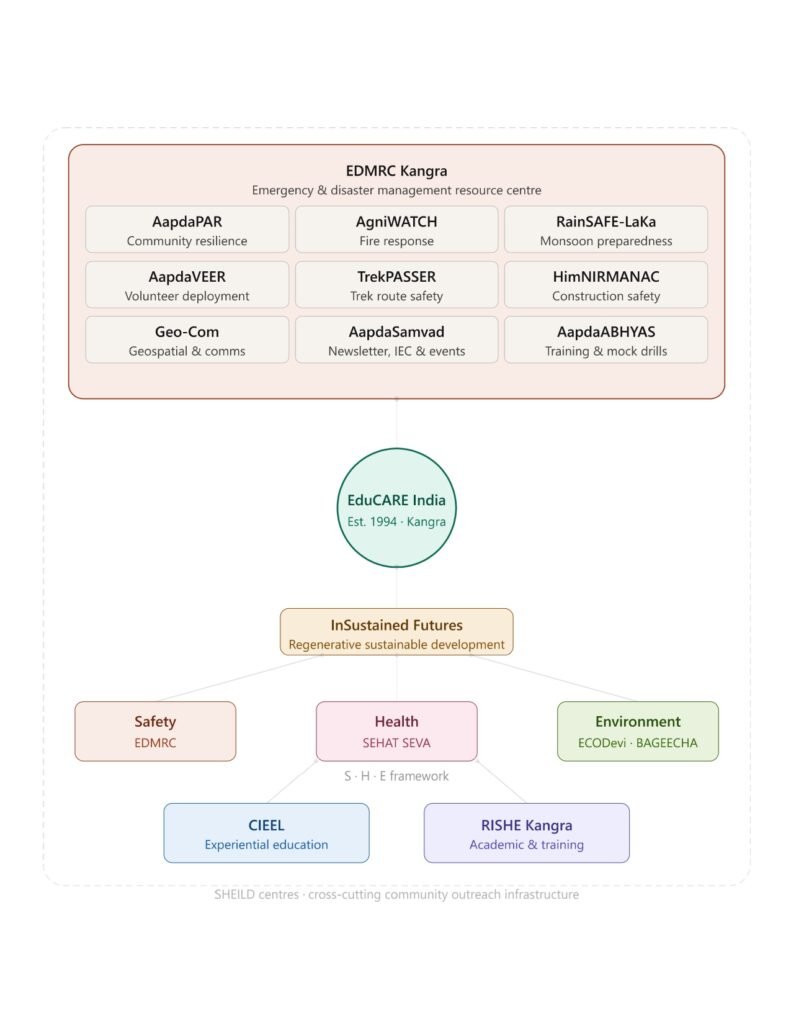
EDMRC is one of several specialised verticals operating under the EduCARE India umbrella. Together, these institutions create an integrated approach to community resilience:
EDMRC Kangra — Emergency & Disaster Risk Management & Resilience Centre. Disaster mitigation, preparedness, emergency response, volunteer deployment, and hazard research. The operational backbone of all disaster management programmes.
RISHEE Kangra — Regional Institute for Safety, Health, Environment and Empowerment. The academic and training arm, delivering certificate programmes, vocational courses, and the planned PG Diploma/MBA in Disaster Management. Three verticals: EDMRC, SEHAT SEVA Sansthan, ECODEVA Sansthan, and ViKAAS Centre for the Sustainable Empowerment of Vulnerable Individuals and Communities.
SEHAT SEVA — Community Health & Geriatric Care. Health integration within disaster risk reduction, operating through SHG networks to serve elderly and vulnerable populations. Includes VNS-SSK (Village Nursing Station – SEHAT SEVA Kendra) elder care nodes.
CIEEL — Centre for Innovation in Experiential Education and Learning. International internship programmes (GlobalPEACE), corporate training (Field Immersion Cohorts, Cross-Cultural Leadership Sprints, CSR Programme Design), and experiential education. Revenue from corporate programmes funds student scholarships through a 30% ring-fencing model.
ECODEVA Sansthan — Ecological restoration, environmental conservation, and green economy initiatives including the BAGEECHA programme and ecoREstore social business hubs.
ViKAAS Centre — Vision, Knowledge & Action for Advancement and Sustainability — works for the sustainable empowerment of vulnerable individuals and communities through education, skills, livelihoods, inclusion, and community-based outreach for holistic social advancement.
Our Geography
Kangra District, Himachal Pradesh, is among India’s most hazard-prone districts. Situated in the western Himalayas, the district’s terrain produces a complex overlay of natural hazards:
Seismic Risk: Located in Seismic Zone IV and V, with a history of devastating earthquakes including the 1905 Kangra earthquake (magnitude 7.8), one of the deadliest in Indian history.
Monsoon Hazards: Annual monsoon brings intense rainfall triggering floods in the Beas, Banganga, and other river systems; landslides on steep slopes; flash floods in narrow valleys; and progressive soil subsidence.
Forest Fires: Extensive pine forests (chir pine) are highly fire-prone during pre-monsoon months, threatening settlements, biodiversity, and watershed integrity.
Climate Vulnerability: Changing precipitation patterns, glacial dynamics, and temperature shifts are altering traditional hazard patterns, making community-level preparedness more critical than ever.