EDMRC’s Volunteer Engine
AapdaVEER is EDMRC Kangra’s unified volunteer mobilisation, training, and deployment framework — the operational backbone that powers every field programme in the EDMRC ecosystem.
While individual programmes like AgniWATCH, RainSAFE Land, and TrekPASSER define what needs to be done, AapdaVEER defines who does it. It is the system through which volunteers are identified, recruited, trained, certified, and continuously deployed across Kangra District’s disaster management infrastructure.
What makes AapdaVEER distinctive is that it does not build a parallel volunteer structure from scratch. Instead, it converges multiple existing government and community volunteer streams into a single, operationally coherent deployment framework managed by EDMRC Kangra.
Volunteer Streams Converging Under AapdaVEER
AapdaVEER draws from and integrates multiple volunteer mobilisation channels:
1. EDMRC’s Own Volunteer Cadre
Volunteers mobilised and trained continuously by EDMRC Kangra through direct recruitment drives, community outreach, and field partnerships. These are the volunteers who have been part of EDMRC’s operational ecosystem over two decades — the foundation on which everything else is built. Many carry multi-year field experience across disaster response, community health, and environmental conservation.
2. State Government: Youth Volunteer Taskforce for DRR
The Himachal Pradesh State Government’s scheme for creating a Taskforce of Youth Volunteers for Disaster Risk Reduction and Response. AapdaVEER serves as the district-level implementation mechanism in Kangra, giving the state scheme an operational home with established training infrastructure, deployment protocols, and community networks.
3. Government of India — NDMA Schemes
Aapda Mitra: The National Disaster Management Authority’s flagship community volunteer programme. NDMA-certified volunteers trained in search and rescue, first aid, incident command, hazard assessment, and community preparedness. In Kangra, EDMRC has built one of the country’s most active Aapda Mitra networks — volunteers who are not passive certificate-holders but actively deployed across EDMRC programmes.
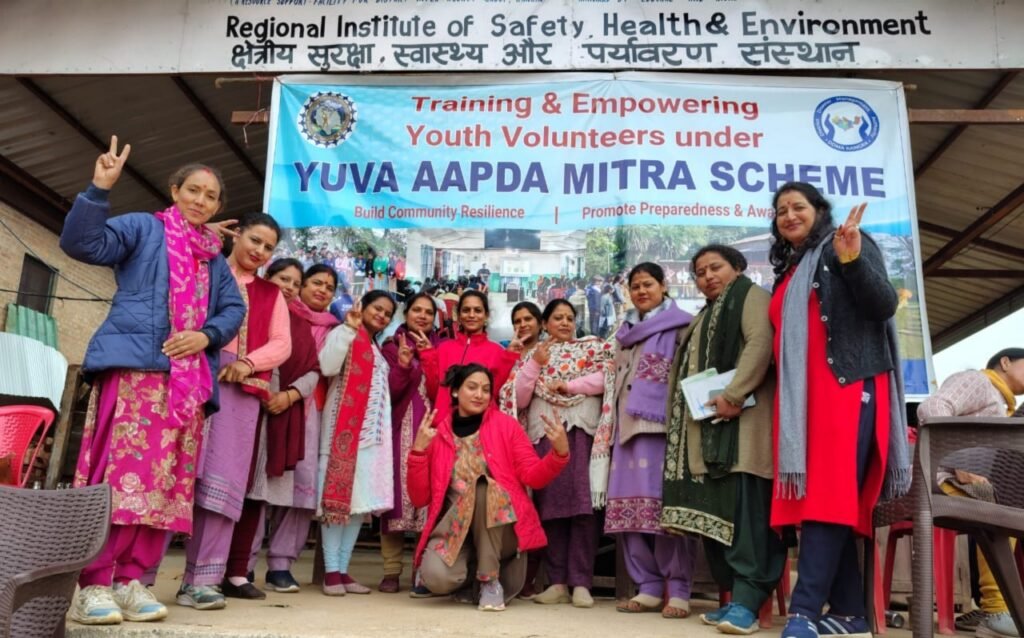
Yuva Aapda Mitra: The youth-specific variant of the Aapda Mitra programme, targeting young men and women aged 18–35. EDMRC recruits through two primary channels: direct recruitment from Kangra District youth, and the CRP/CLF cadre women already active in the DAY-NRLM/NRLM Self-Help Group ecosystem. The CRP/CLF pathway is particularly significant — these women add disaster management certification to their existing community development roles, building on established trust, networks, and institutional structures.
4. EduCARE’s VARISHTHA Mandals
Senior citizen volunteer groups mobilised through EduCARE’s community networks. VARISHTHA Mandals bring a different but essential capability: institutional memory of past disasters, deep local knowledge of terrain and hazard patterns, social authority within communities, and the ability to serve as mentors and advisors to younger volunteers. In disaster preparedness, the experience of elders who remember the 1905 earthquake’s legacy or decades of monsoon patterns is irreplaceable.
5. SEHAT SEVA Self-Help Groups
Women’s SHGs operating under the SEHAT SEVA health and geriatric care vertical. These groups are already embedded in community health infrastructure — through AapdaVEER, they add disaster preparedness and response capabilities to their existing health roles. SHG members serve as the first point of contact for vulnerable populations (elderly, chronically ill, persons with disabilities) during emergencies, and as community health communicators during disaster events.
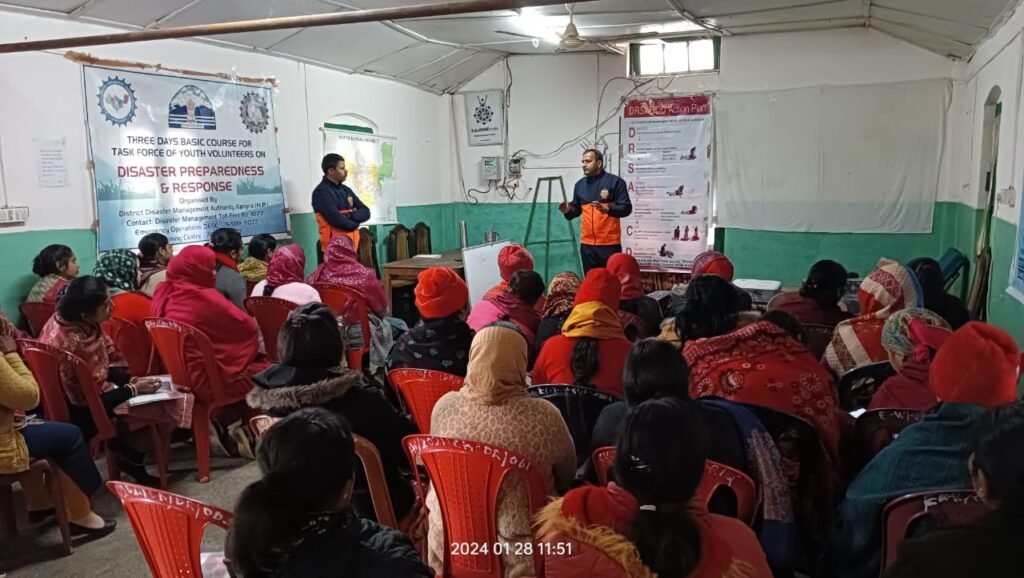
■ PHOTO:
(1) Young volunteers in training — YAMS/direct recruits,
(2) CRP/CLF women in a disaster management session,
(3) VARISHTHA Mandal members in a community setting,
(4) SEHAT SEVA SHG women during health + disaster preparedness activity,
(5) Mixed group showing the convergence — young and old, men and women, community and institutional.
The “AapdaVEER, Kangra”
All EDMRC’s field programmes carry the unified convergent name – Aapda VEER / Aapda Mitra, Kangra.” This is deliberate. While each programme — AgniWATCH, RainSAFE Land, TrekPASS, AapdaPAR — has its own identity and operational logic, the volunteers who power them share a common training foundation and institutional home under AapdaVEER.
Wherever there is an EDMRC programme in Kangra, there is an AapdaVEER / Aapda Mitra behind it.
Deployment Pathways
Once mobilised and trained through AapdaVEER, volunteers are deployed across EDMRC’s full programme suite based on their skills, training level, location, and availability:
FireWATCH: Fire station embedding and forest fire response. Volunteers serve structured rotations at fire stations across Kangra, supplementing formal fire service capacity.
RainSAFE-Land: Six-month monsoon season deployment (May–October) across subdivisions — Flood, landslide, and subsidence monitoring – mitigation, preparedness and first response.
AapdaPAR: Panchayat-level CBDRM coordination, IRT and WERRT membership, VDMP implementation, and PERC management.
TrekPASS: Trek route safety and accountability at chokepoints. Volunteers stationed at key access points along popular and hazardous trek routes across Kangra.
HimNIRMANAC: Construction and habitat safety assessments. Volunteers trained in basic structural awareness supporting post-disaster building inspection and safe construction awareness.
BikeLIFER: Motorcycle-based rapid first response units for deployment across difficult terrain where ambulance or vehicle access is limited.
SEHAT SEVA Nodes: VNS-SSK (Village Nursing Station – SEHAT SEVA Kendra) elder care and health preparedness roles, particularly for SHG and VARISHTHA Mandal members.
Training & Certification
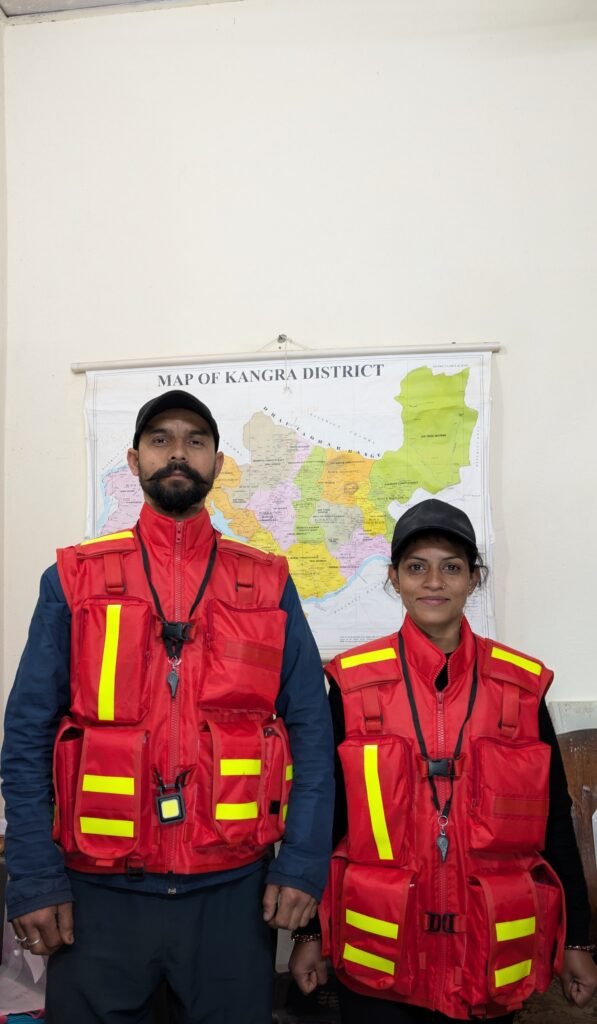
AapdaVEER’s training architecture is delivered through AapdaABHYAS (Aapda Bachaav Hetu Abhyas, Yojana aur Sakshamta) — EDMRC’s dedicated training, mock drill, and readiness initiative. Volunteers progress through:
Foundation Training: 4–6 week initial certification covering search and rescue, first aid, incident command basics, hazard assessment, community preparedness, and communication protocols.
Specialisation Modules: Programme-specific training for AgniWATCH (fire safety), RainSAFE-Land (monsoon hazards), TrekPASS (mountain rescue), HimNIRMANAC (construction safety), and Geo-Com (GIS/communication tools).
Regular Mock Drills: Scheduled simulation exercises at panchayat, block, and district levels ensuring readiness is maintained, not just achieved.
Continuous Skill Upgradation: Refresher training, new hazard briefings, equipment familiarisation, and cross-programme exposure ensuring volunteers remain operationally current.
Current Status
Three cohorts of 60 nominated volunteers is in various stages of training and deployment across Kangra. The AapdaVEER framework is designed for rapid scaling — from Kangra to other Himachal Pradesh districts and eventually national replication — because it builds on government schemes and community structures that already exist everywhere.
Call to Action
Join AapdaVEER — Become your community’s first responder.
Open to men and women aged 18–35 from Kangra District. Also open to VARISHTHA Mandal members, SEHAT SEVA SHG members, and CRP/CLF cadre women seeking to add disaster management certification to their community development roles. (though opportunities available for SHG and ex-servicemen till 45 yrs age, and to elders above 60 yrs age)
Training, certification, and deployment across EDMRC programmes provided by EDMRC Kangra in partnership with DDMA Kangra.
Already a trained volunteer? Register with AapdaVEER to join the deployment network.